-
- Coventry City Football Club

Coventry City Football Club has very humble beginnings dating back to October 1883, when a group of workers from Singers Cycle Works in the Hillfields area of the city, headed by William Stanley, set up a works-based football team when their previous club, Coventry Association, folded.
Singers FC as they were known struggled to compete in their early years, joining the Birmingham League in 1894 and frequently moving ground, playing at Dowell’s Field, Binley Road (1883-87) and Stoke Road (1887-99). In 1898 the club changed its name to Coventry City F.C., and a year later they moved to a more permanent home in Highfield Road, where they would remain for the next 106 years.
Much of the time since has been spent struggling both on and off the pitch. This has included a few relegations (dropping into Southern League Division 2 in 1914, Division 3 in 1925 and even as low as Division 4 in 1958-59) as well as nearly going out of business completely at the outbreak of World War I before being rescued by David Cooke, and officials of the club being found guilty of fixing a match against Bury in 1919/20, their first season in the Football League.
But there have been highs along the way. In 1909 the club (which was still largely amateurish at the time) reached the FA Cup quarter-finals.
The promotion back to Division 2 in 1936 and looking on course to reach the top flight until World War II stopped them in their tracks is another high point, with the entire Harry Storer-era of the 1930’s being considered a golden age for Coventry City. Clarrie Bourton was the talismanic forward in a free-scoring attacking team, and with 182 goals remains the clubs all-time leading goalscorer.
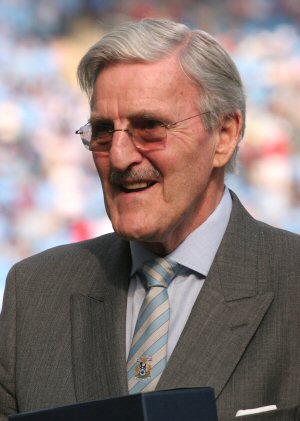
Post-war the club entered the doldrums again and slipped down the leagues, but this ultimately brought about the appointment of the charismatic Jimmy Hill in 1961, who changed the club from top to bottom, and was responsible for the Sky Blue kit and nickname and the famous club song Play Up Sky Blues, based around the Eton Boating Song.
As well as this, Hill completely reinvented the matchday experience, bringing in a matchday programme, cheerleaders, half-time entertainment and competitions and numerous other innovations that drew in the crowds and helped the Sky Blues back up the leagues, gaining promotion to the top flight in 1967 with victory over Wolverhampton Wanderers in front of the club’s highest attendance (officially 51,455 although it’s widely believed to have been much higher – people were sat on the floodlight pylons and right on the edge of the pitch). When Hill resigned before the start of that first season in the top flight to pursue a media career, fans were shell-shocked and has left every fan every since wondering “What If?”
That didn’t stop the club reaching Europe in 1970/71, and Coventry were the only team to beat eventual winners Bayern Munich (including Franz Beckenbauer and Gerd Muller) in the Fairs Cup that year (despite losing heavily on aggregate). The same year also saw Ernie Hunt and Willie Carr’s legendary donkey kick free-kick, which was outlawed after the game and will never be repeated.
Coventry were also the first club to have an all-seater stadium in the 1980’s to try and eradicate hooliganism, but the plan backfired when yobs realised the seats made fantastic weapons…

But by far the greatest day in Coventry City’s history is May 16 1987 when, managed by John Sillett and club legend George Curtis, the club finally won some silverware, winning the FA Cup 3-2 against Tottenham in what is described as one of the best finals ever seen. David Bennett and a sublime diving header by Keith Houchen twice brought Coventry back on level terms before an own goal off Gary Mabbutt’s knee in extra time helped the Sky Blues shock their illustrious opponents and the football world in general, with skipper Brian Kilcline hobbling up the Wembley steps to proudly lift the trophy aloft.
For 34 years the Sky Blues steadfastly refused to relinquish their place at the top table despite numerous relegation battles, becoming the 4th longest serving members of the top flight behind Arsenal, Everton and Liverpool and becoming founder members of the Premier League in the process. It led to the phrase “if the Titanic had been painted Sky Blue it would never have gone down” but this record was made with a highly contentious 2-2 draw with Bristol City in 1976 after a late kick-off allowed both teams to know that the draw would be enough to keep them both up.
But in 2001 the club finally dropped out of the top flight after some high risk gambles by the overly-ambitious Bryan Richardson failed to pay off, and the high transfer fees paid out and his desire to build a new stadium left Coventry City with debts of around £60m and on the brink of going out of business.
The club struggled through the next five years, moving into the much smaller than envisaged 32,609 seater Ricoh Arena in 2005 (but only as tenants) and despite the much improved facilities the ground has yet to be adopted as ‘home’.
2007 saw the profligacy of the 1990’s come to a head, with the Sky Blues 30 minutes away from administration before being bought by investment firm SISU and ex-professional Ray Ranson.
Even so the club continued to struggle. Relegation to League One in 2012 was followed by administration in 2013 and a controversial ground-share at Sixfields in Northampton as disputes over the Ricoh Arena forced the club to play its home games away from Coventry. The return to the city in 2014 brought some stability, but performances remained inconsistent, culminating in relegation to League Two in 2017.
Under Mark Robins, the club began to rebuild, but not before experiencing one of the most bittersweet seasons in its history. In April 2017, Coventry lifted the EFL Trophy at Wembley, defeating Oxford United 2-1 to claim their first trophy in three decades. Just weeks later, however, relegation to League Two was confirmed.
The 2017-18 season proved to be a turning point. Coventry secured a play-off place on the final day with a draw against Morecambe. After a 1-1 draw in the semi-final first leg, they produced a superb performance to defeat Notts County 4-1 away. This set up a Wembley final against Exeter City, where Coventry won 3-1 on 28 May 2018 to secure promotion back to League One.
Momentum continued to build, and in 2020 Coventry were crowned League One champions, returning to the Championship despite playing home fixtures at St Andrew's Stadium due to ongoing stadium issues. A full return to the Coventry Building Society Arena in 2021 helped restore a vital connection with supporters.

A major turning point off the pitch came in November 2022 when Doug King acquired an 85% stake in the club, before completing a full takeover in January 2023. His arrival marked the beginning of a new era of stability after years of uncertainty.
That stability helped underpin one of the club’s most memorable modern seasons. In 2023, Coventry reached the Championship play-off final at Wembley against Luton Town. After a tightly contested match ended level, Coventry were defeated on penalties, falling agonisingly short of a return to the top flight.
The following season brought another unforgettable run, this time in the FA Cup. In 2024, Coventry reached the semi-final, where they faced Manchester United. After a dramatic comeback to draw level, the match went to penalties, with Coventry once again suffering heartbreak.
However, the next season proved more challenging. Struggling in the Championship and sitting 17th, King made the difficult decision to part ways with Mark Robins in 2024, bringing an end to a hugely significant managerial era.
His successor, Frank Lampard, revitalised the side and led Coventry into the play-off semi-finals. In a dramatic tie against Sunderland, Coventry were eliminated by a last-minute goal in extra time in the second leg away from home.
Off the pitch, long-awaited stability was fully secured in August 2025 when King completed the purchase of the Coventry Building Society Arena from Frasers Group, reuniting the club with ownership of its home.
That stability finally translated into success on the pitch. Building on previous near-misses, Lampard led Coventry through a successful campaign that culminated in promotion back to the Premier League.
From administration, exile from their own city, and a spell in the fourth tier, Coventry City have completed one of the most remarkable recoveries in English football—rebuilt, reconnected with their supporters, and firmly back where they belong.

Written By AD & Chris - History collated from ccfc.co.uk and Coventry City Footballers: The Complete Who's Who by Martin and Paul O'Connor